




Which Gas Heating Systems Are Best for Industrial Buildings?
The two main gas-fired heating systems for industrial buildings are gas-fired warm air heaters and gas radiant tube heaters. Warm air heaters, including suspended units and floor-standing cabinet heaters, are the most common choice for heating the whole floor of a factory, warehouse or distribution centre. Radiant tube heaters work better where heat is only needed in certain zones, such as a production line or packing area.
How Do Gas-Fired Warm Air Heaters Heat an Industrial Building?
A gas-fired warm air heater burns natural gas or LPG and passes the heat through a heat exchanger inside the unit. A fan blows air from the building across the heat exchanger, then pushes the warmed air down and across the floor. The combustion gases leave through a flue, so they stay out of the working area.
The warmed air keeps circulating, which is how industrial warm air heating brings a whole factory or warehouse up to temperature.
Chillaire’s main warm air heaters are:
– The Powrmatic CPx and VPx floor-standing cabinet heaters
– The Powrmatic LX roof suspended range and Winterwarm XR range
– Combat warm air heaters, including suspended, condensing and cabinet models
– Reznor warm air heater products
At Brennan Industries’ new warehouse in Walsall, Chillaire installed two Powrmatic LX140F heaters with horizontal flues to avoid cutting holes in the roof. We have also fitted Winterwarm XR20 and XR50 heaters, each with a room-sealed flue.
What Do High and Low Fire Mean on a Warm Air Heater?
High and low fire means a gas warm air heater can run at two heat output levels. High fire brings a cold building up to temperature quickly, and low fire holds that temperature using less gas.
Chillaire’s Powrmatic LX120F installation in Coventry shows how this works. On high fire, the single roof suspended heater delivers up to 118 kW. Once it has overcome the building’s heat loss, or in milder weather, it switches to low fire at 67 kW. Its fans throw warm air a long way across open space, so one heater can cover a wide area.
When Are Floor-Standing Cabinet Heaters Used?
Floor-standing cabinet heaters are gas-fired warm air heaters that stand at floor level or in a plant room. They are used in factories and workshops with limited ceiling height and in buildings where warm air needs ducting to several areas.
A cabinet heater draws in air, heats it and either blows it straight into the space through adjustable outlets or sends it through ductwork. Being at floor level also makes the heater easier to reach for servicing.
Chillaire installs floor-standing cabinet heaters from leading brands, such as Powrmatic, Winterwarm, Combat and Reznor.
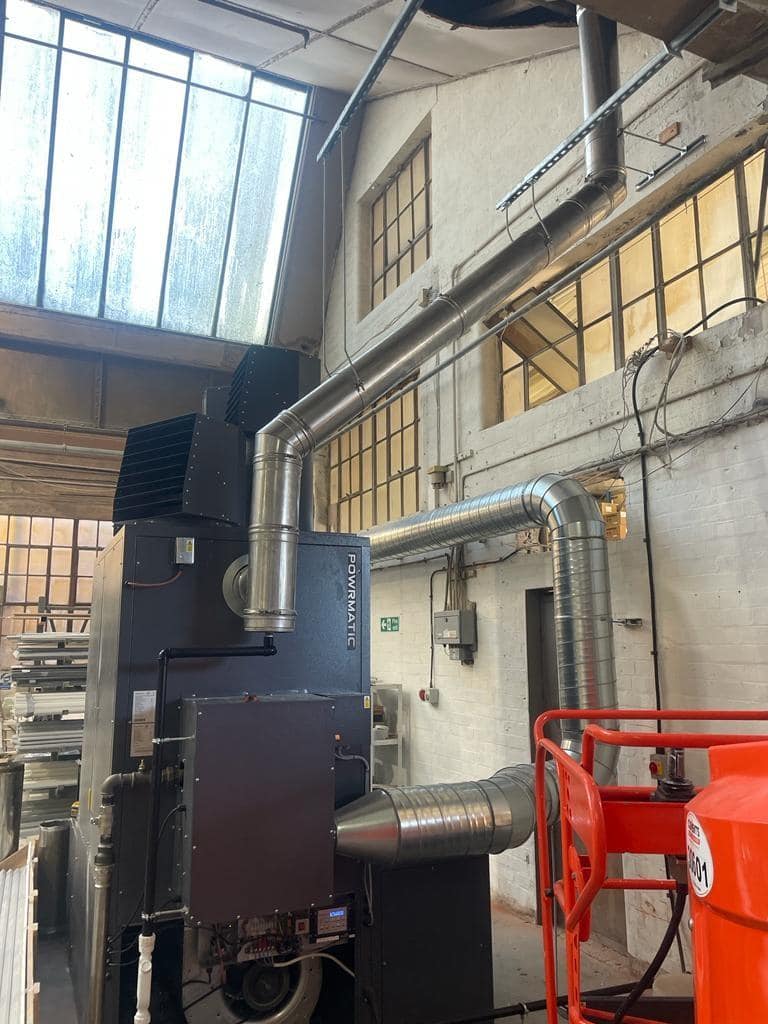
Pictured below is a Powrmatic VPx our team completed in Coventry. It feeds warm air into ductwork that runs along the wall.
Where Do Gas Warm Air Heaters Work Best?
Gas warm air heaters work best in large, open buildings that need an even temperature across the whole floor.
Typical industrial applications for gas warm air heaters include:
Factories
Factories need clear floor space for machinery, conveyors and walkways. Factory gas heaters are usually suspended from the roof steelwork, which keeps the floor clear for machinery, racking and forklift routes.
Production Facilities
Production facilities can have dust in the air from manufacturing processes. Room-sealed heaters take their combustion air from outside through the flue, keeping the burner clear of that dust.
Warehouses
Warehouses have tall racking that can block warm air, which means gas heating for warehouse buildings is planned around the aisles. At Impact in Corby, Chillaire placed a bi-directional Powrmatic heater in the middle of the warehouse to blow warm air out from both sides.
Workshops
Workshops have vehicles, benches and tools across the floor, so industrial workshop heaters are fixed to the roof beams or walls. Chillaire fitted a roof-suspended Powrmatic heater in Richardson Racing’s Corby workshop, where race cars are serviced and repaired.
Distribution Centres
Distribution centres often need heat across long shifts, and a lower output setting keeps gas use down once the space is warm.
Large Open Industrial Spaces
Large open industrial spaces can be covered by a small number of powerful heaters, with destratification fans pushing rising warm air back down. At Production Concepts’ warehouse, Chillaire paired two Powrmatic heaters with five of these fans.
When Are Gas Radiant Tube Heaters the Better Choice?
Gas radiant tube heaters are the better choice for industrial buildings when only part of a building needs heating or when loading doors open throughout the day. They warm people, machinery and surfaces directly, so less heat is lost when warm air escapes through open doors or rises into the roof. Staff will feel the warmth almost as soon as the tubes switch on.
A burner fires a long flame inside a steel tube mounted overhead. The flame heats the tube, and the tube sends radiant heat downwards, much like sunlight. An exhaust at the end of the tube carries the combustion gases outside.
Radiant tubes work well in these parts of an industrial building:
– Production areas with fixed workstations can be heated along the line, while the rest of the building stays cooler.
– Sections of a warehouse, such as a packing area, can be kept warm without heating the storage aisles around them.
– Workshops and vehicle bays stay comfortable for staff working under the tubes, even with roller doors opening for deliveries.
– Older or poorly insulated factory bays can be heated across the whole bay. Floors and surfaces hold the warmth, so the tubes can be switched off before the end of the working day.
– Chillaire supplies and installs gas radiant tube heaters from Powrmatic, Winterwarm, Combat and Reznor in both linear and U-tube layouts.
How Do Warm Air and Radiant Tube Heaters Compare?
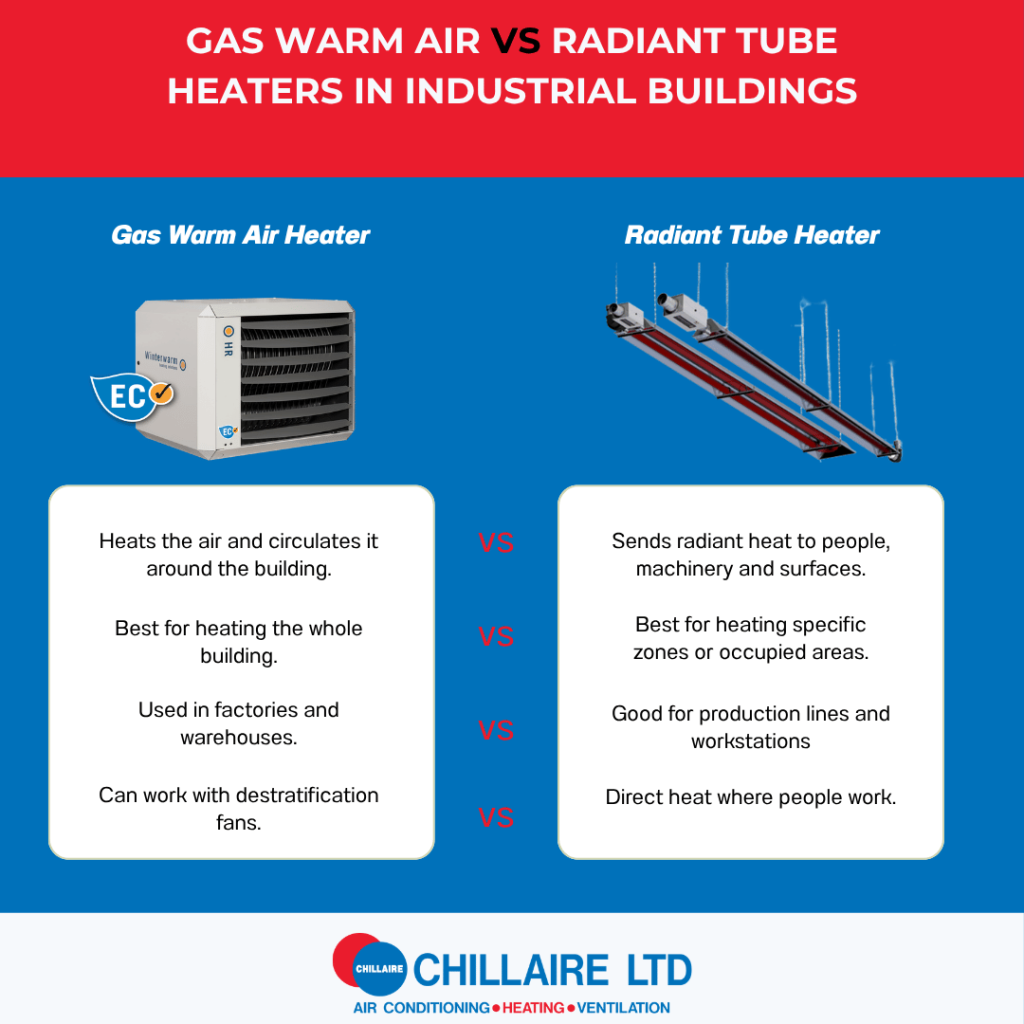
Gas warm air heaters heat the whole building, and gas radiant tube heaters target the zones where people work. Both are widely used industrial gas heaters, so the right choice depends on the layout of the building and where staff spend their time.
How Do You Choose the Right Industrial Gas Heating System?
The right industrial gas heating system depends on the size of the building, the work carried out in it and its operating hours.
At Chillaire, we offer a free site survey where we check these factors before recommending the right industrial heating system:
– Building dimensions and ceiling height to decide how many heaters are needed, where they hang and how far each one throws warm air.
– Required heat output is calculated from the building’s heat loss and the temperature you need to hold.
– Insulation controls how quickly heat escapes through the roof and walls, which changes the output needed.
– Doors that open often let cold air in, so busy loading bays may need radiant tubes or extra heat close to the doors.
– The area that needs heating may be the full floor or a single production line or packing area. Heating only the occupied zones can cut gas use in buildings that are mostly storage.
– Where employees work shows where heat needs to reach. Fixed workstations can be heated directly with radiant tubes.
– Existing gas infrastructure sets the scope of the job, as new heaters may need pipework run from the meter or an LPG tank.
– Controls and operating hours shape running costs.
– Flue requirements vary between buildings. A horizontal flue exits through a wall without cutting into the roof, and a vertical flue goes up through the roof.
– Destratification fans may be needed in tall buildings to push warm air from the roof back down to the working area.
Chillaire designs each system around the building it will heat. Our industrial projects have covered heaters, flues, controls, gas mains and destratification fans, all planned and fitted by one team.
Read our guide to the different types of industrial heating systems, where we look at warm air heating, radiant tube heating, heat pumps and destratification fans in more detail.
Which Gas Heater Brands Are Used in Industrial Buildings?
Industrial gas-fired heaters come in suspended, floor-standing and radiant tube versions. The main manufacturers Chillaire works with are: Powrmatic, Winterwarm, Combat and Reznor.
The main ranges Chillaire supplies and installs into factories, production facilities, workshops, distribution centres and warehouses are:
The Powrmatic LX
The Powrmatic LX is a range of industrial suspended gas heaters that hang from the roof over factory floors, warehouses and workshops. It was developed from Powrmatic’s LNVx range and meets ErP 2021 requirements for seasonal efficiency and NOx emissions. Versions include crossflow, downflow and bi-directional fan units, so the airflow can be matched to the building.
The Powrmatic VPx and CPx
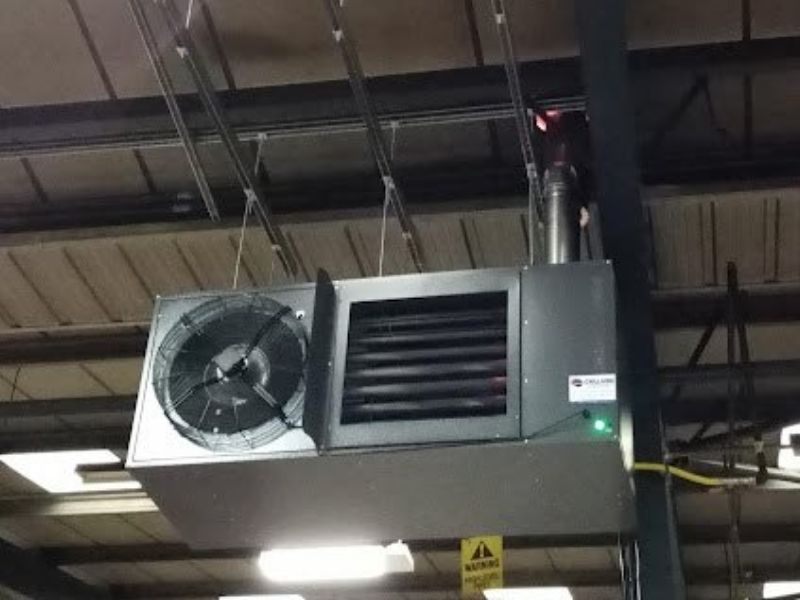
The Powrmatic VPx is a floor-standing gas cabinet heater with outputs up to 140 kW and high and low burners. It can run room sealed or flue only, with vertical or horizontal flue options that cut down on holes through the roof. Free blowing and ducted versions are available, and stainless steel heat exchangers can be specified for industrial environments.
The Powrmatic CPx runs on gas, LPG or oil, with outputs from 30 kW up to 590 kW for the largest buildings. It can stand in the heated space or in a plant room, and adjustable nozzle heads direct the warm air where it is needed.
The Winterwarm XR
The Winterwarm XR is a gas-fired warm air heater that can blow warm air horizontally or vertically. Its temperature gradient control uses one sensor in the heater and another in the working zone. When heat builds up under the roof, the fan pushes it back down, so the heater also acts as a destratification fan. When the room cools, a modulating burner and three-stage fan supply the amount of heat needed.
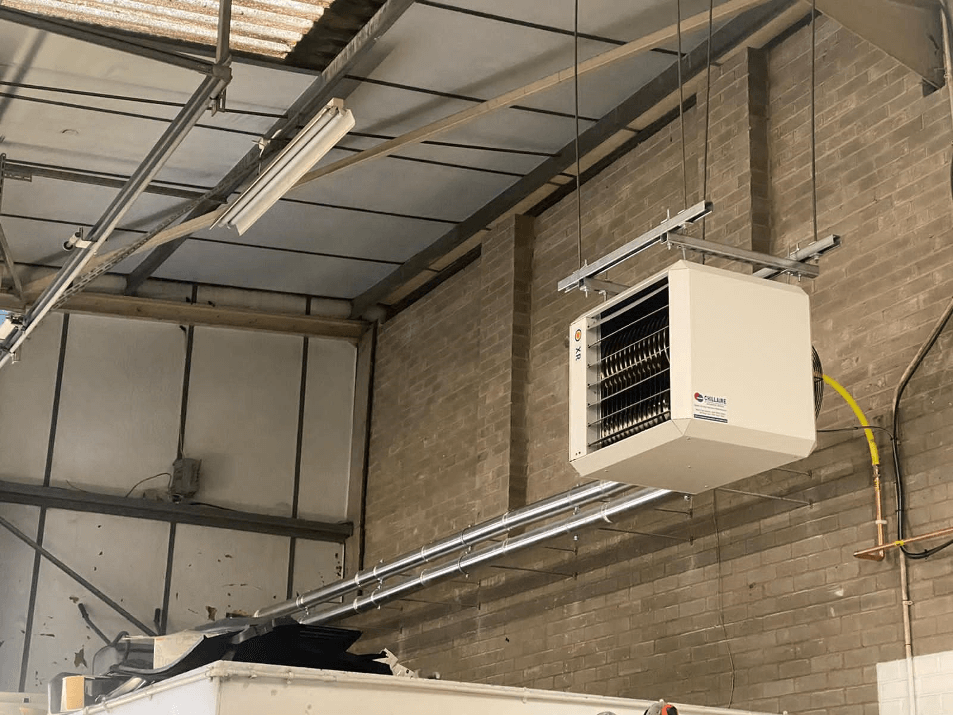
Combat Warm Air Heaters
Combat has an extensive range of industrial heaters, which include:
– Combat ELG and ELO Cabinet Warm Air Unit Heaters
– Combat ELUA Suspended Warm Air Unit Heaters
– Combat Elite Suspended Warm Air Unit Heaters
– Combat ECO Condensing Warm Air Unit Heater
The Combat Elite Pro suspended unit heaters cover 30 to 115 kW, with a fully modulating burner and stainless steel heat exchangers. They can be room sealed or open flued, and suspended or shelf mounted. Combat also makes floor-standing cabinet heaters, compact heaters for smaller buildings and radiant tube systems.
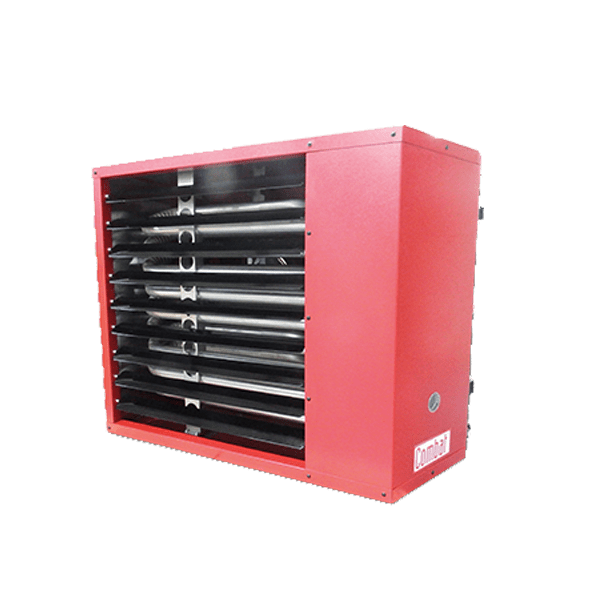
Reznor Heaters
Reznor makes suspended unit heaters and radiant tube systems for industrial buildings. Its RHeco suspended heaters are low NOx condensing units with a four-pass heat exchanger. The Comet+ cabinet heaters reach combustion efficiencies of up to 94%, with condensing and weatherproof external versions available.
Radiant Tube Heaters
Powrmatic and Winterwarm radiant tube heaters give targeted heat over production zones, packing areas and other occupied parts of larger buildings. Powrmatic’s linear and U-tube models cover 10 to 60 kW, with high fire for a quick warm-up and low fire for steady running. Winterwarm’s WRU and WRL tubes can boost heat at workstations, with a small warm air system holding a background temperature.
Chillaire supplies radiant tube systems and heaters from all four brands, along with Powrmatic CEC destratification fans for taller buildings.
What Does Installing Gas Heating in an Industrial Building Involve?
Installing gas heating in an industrial building means fitting the heaters, flues, gas supply, electrics and controls, then commissioning and servicing the system. A typical gas heating installation runs through these stages:
– A site survey measures the building and looks at how each area is used.
– The system is designed around the survey, with the heater type, output and positions chosen to match the building.
– Heaters are delivered directly to the site.
– Our Gas Safe registered engineers install the flues, new gas pipework, mains electrics and controls.
– Engineers commission the system and set the controls to the site’s working hours.
– Industrial and commercial clients are offered planned preventative maintenance contracts which include scheduled visits to keep the heaters running safely once the system is in use.
Gas heaters should be serviced at least once a year. We recommend two visits a year for most industrial sites. Our maintenance agreements can cover heaters, burners and other HVAC plants, with 24-hour breakdown cover included for contract customers.
Industrial Gas Heaters at Chillaire
Chillaire designs and installs industrial gas heaters for factories, production facilities, workshops, distribution centres and warehouses. We handle heater selection, supply, installation and planned maintenance for each industrial heating project. We have over 20 years’ experience installing industrial heating systems across the Midlands and throughout the UK.
Contact us today to book a free site survey for your industrial building. We can recommend a heating system suited to your building and workflow.