

Commercial HVAC Maintenance Checklist

Commercial HVAC Maintenance Checklist

Commercial HVAC systems integrate heating, cooling and ventilation components to maintain the indoor climate in commercial buildings. Because they rely on many interconnected components, it is essential they are well-looked after to keep everything running smoothly.

A preventative approach to commercial HVAC maintenance helps avoid the “domino effect”. A minor issue, such as a worn belt or blocked filter, puts extra strain on other components and eventually leads to a costly breakdown.

At Chillaire, we have over 30 years of experience working with commercial and industrial HVAC systems. Many of the breakdowns we attend could have been avoided with routine maintenance and servicing. Here, we’ll share a commercial HVAC maintenance checklist and explain why investing in a maintenance contract can save your business time and money.

What Happens Without Regular Commercial HVAC Maintenance?

Without regular maintenance, commercial HVAC systems gradually become less efficient and more likely to break down. Small issues that are ignored can quickly turn into expensive repairs for your business.

  • Higher energy bills as dirty filters, blocked coils and restricted airflow force the system to work harder
  • Unexpected breakdowns when minor faults are left unresolved and develop into major failures
  • A shorter system lifespan caused by increased wear and tear on critical components
  • Compliance risks if essential F-gas leak checks, gas safety inspections or TM44 assessments are missed
  • Invalidated manufacturer warranties due to a lack of documented routine servicing

Like a car, your HVAC system needs regular servicing and maintenance to keep it running reliably and to avoid unnecessary costs.

What is Planned Commercial HVAC Maintenance?

Planned maintenance for commercial HVAC maintenance involves regular servicing under a scheduled agreement. Rather than waiting for a breakdown, certified engineers inspect, clean and test your HVAC unit at set intervals throughout the year. 

At Chillaire, planned maintenance runs under annual service maintenance agreements. We contact you when a service is due, and our engineers follow a comprehensive maintenance checklist to ensure every component is inspected, tested and operating efficiently.

Commercial HVAC maintenance checklist:

  • Air filters inspected and Fascia’s cleaned or replaced
  • Evaporator and condenser coils cleaned
  • Refrigerant levels and operating pressures checked
  • F-gas leak checks completed and recorded
  • Condensate drains and drip trays cleared
  • Electrical connections, wiring and controls inspected
  • Thermostats and BMS settings tested 
  • Fan motors, bearings and belts checked for wear
  • Heat exchangers, pipework and insulation visually inspected
  • Airflow measured across vents and returns

We offer a range of planned maintenance agreements to suit businesses of all sizes. You can read more about how our planned maintenance agreements work and choose the level of cover that’s right for your business.

What Does a Commercial HVAC Maintenance Contract Include?

A commercial HVAC maintenance contract should do more than schedule routine servicing. It should help reduce downtime, simplify compliance and ensure your system is maintained by qualified engineers throughout the year. Before choosing a provider, check your agreement includes the following:

  • Scheduled servicing managed for you: Your provider should contact you when a service is due and perform preventative maintenance (PPM) visits around your operations.
  • Full reporting: Every visit should produce a detailed service report with clear pricing for any recommended repairs.
  • Flexible agreement levels: Call-outs and consumables can be included, so the contract matches your site and budget.
  • Qualified engineers: Look for F-Gas certification, City & Guilds qualifications and Gas Safe registration for heating work.

At Chillaire, our planned maintenance contracts also include a 24-hour breakdown service, 7 days a week, 52 weeks a year, with an out-of-hours emergency line for contract customers.

Routine Commercial HVAC Checks Your Team Can Carry Out

Although servicing should be left to qualified engineers, your team can still carry out simple routine checks to spot signs of wear, damage or poor performance between maintenance visits.

  • Listen for unusual noises, vibrations or smells when units start up
  • Verify thermostat settings and room temperatures across different zones
  • Keep vents and returns clear of furniture, stock and dust
  • Clear leaves and debris around outdoor units
  • Log performance changes and unexpected rises in energy use

Report anything unusual to your HVAC maintenance provider straight away. A strange noise today is often a breakdown next month.

Looking for more ways to keep your system running efficiently? Check out our 5 HVAC maintenance tips for any commercial building.

How Often Should Commercial HVAC Systems Be Serviced?

Air conditioning and heat pump systems, as well as gas-fired, oil-fired and LPG heating systems, should be inspected, cleaned and serviced at least once a year. At Chillaire, we recommend a visit every six months in most commercial settings. This protects your systems’ life expectancy and keeps them running at maximum energy efficiency. Having an annual service also maintains manufacturer warranties. Commercial premises with high heating and cooling needs such as commercial kitchens and manufacturing facilities may need more frequent maintenance and servicing.

Why Choose Chillaire for Commercial HVAC Maintenance?

Chillaire has provided commercial HVAC maintenance and air conditioning maintenance since 1992. Our head office is in Coventry, and regional offices across the Midlands allow us to deliver a national service through locally based engineers. We support commercial, industrial and retail and leisure sites of every size, and planned preventative maintenance agreements are tailored around the customer. Our engineers can design, install and maintain:

  • Air conditioning and VRF systems
  • Air-source heat pumps
  • Boiler plants and gas-fired burners
  • Chiller plants
  • Ventilation systems and air handling units
  • Warm air units and air curtains
  • BMS management systems
  • Heat recovery, close control and humidifier systems
  • Air purification plants

Any new service maintenance agreement starts with a free survey and quotation, and every visit is carried out by certified, experienced engineers. Contact our team to discuss a planned maintenance agreement for your site.

FAQS

How much does commercial HVAC maintenance cost?

Commercial HVAC maintenance costs depend on the number of systems on site, the plant types involved and how often visits are needed. Chillaire provides a free survey and quotation for new service maintenance agreements, with flexible contract levels to suit different budgets.

Can Chillaire maintain systems installed by another company?

Chillaire’s engineers work on all major manufacturers, including Daikin, Mitsubishi Electric, Fujitsu and Panasonic. Genuine spares are sourced directly, so equipment installed by other contractors can be brought into a planned maintenance agreement without any issues.

What happens when a fault is found during a maintenance visit?

Any problems identified during a visit are reported back to the office, and a full written report is sent for your attention, including prices for replacement parts or repair work. Repairs are quoted for approval before any work goes ahead, and emergency repairs are available at short notice if a fault needs urgent attention.

AC Planned Preventative Maintenance: Benefits and Costs
Air conditioning systems regulate temperature and support the air quality in commercial and industrial buildings. However, like any complex piece of equipment, they need regular attention to stay reliable. That is why commercial businesses invest in AC-planned preventative maintenance.

We will explain what planned preventative maintenance (PPM) for air conditioning involves and the benefits businesses get from having a service maintenance contract.

At Chillaire, we have been providing commercial air conditioning maintenance across the Midlands for over 30 years. We offer AC planned maintenance agreements and our City & Guilds qualified engineers install commercial and industrial air conditioning systems.

What is AC Planned Preventative Maintenance?

AC planned preventative maintenance is a scheduled programme of inspections, cleaning and servicing carried out on air conditioning systems. Rather than waiting for a breakdown to call an engineer, PPM identifies wear, performance loss and minor faults early so they can be fixed.

An air conditioning service visit will include:

  • Cleaning and inspecting air filters, evaporator coils and airflow
  • Checking and recording refrigerant levels for F-gas compliance
  • Visual inspection of heat exchangers and pipe connections
  • Wiring and electrical safety checks
  • Inspection of insulation and pipework condition
  • Testing system controls and performance
  • Issuing a comprehensive service report

Most commercial systems should be serviced at least once per year as a minimum. Under current F-gas regulations set by the UK government, systems containing larger quantities of refrigerant must be checked more frequently:

  • Systems with 3 kg or more of refrigerant: checked annually
  • Systems over 30 kg: checked every six months
  • Systems over 300 kg: checked quarterly

At Chillaire, we recommend a six-monthly maintenance visit for most commercial systems as standard, regardless of refrigerant charge. This is because twice-yearly servicing gives a far better window to catch seasonal wear and maintain energy efficiency all year round.

What Are the Benefits of Commercial AC Preventative Maintenance?

The benefits of planned preventative maintenance for air conditioning systems are straightforward, especially for commercial and industrial businesses. Systems that are regularly serviced last longer, break down less often and cost less to run. Here is a closer look at what businesses gain.

Fewer Costly Breakdowns

Unplanned air conditioning breakdowns are often more expensive than scheduled maintenance. An engineer call-out, emergency parts and the operational disruption caused by a failed system or part can exceed the annual cost of a maintenance contract. PPM reduces the likelihood of your AC system unexpectedly breaking down by catching small issues before they escalate.

At Chillaire, with our service maintenance agreement, you also gain access to our 24-hour emergency breakdown service.

Extended System Lifespan

A well-maintained commercial air conditioning system will last significantly longer than one that is forgotten about. When a system faces dirty coils, blocked filters or low refrigerant, it has to work twice as hard. This extra strain quickly wears out the compressor and other vital parts. Regular air conditioning maintenance and servicing keeps everything running as the manufacturer intended and helps protect your investment.

Lower Energy Bills

A dirty or poorly maintained AC system has to work harder to reach the same output. Keeping your system clean and correctly charged with refrigerant keeps its energy efficiency as high as possible, which directly reduces your running costs. For more on this, read our article on the energy-saving benefits of modern AC systems.

Maintained Manufacturer Warranty

Most leading AC brands, including Daikin, Mitsubishi Electric and Fujitsu, require evidence of regular servicing to honour their warranties. Skipping maintenance visits can invalidate your warranty and leave you without cover if a major component fails.

F-Gas Regulatory Compliance

Under current UK legislation, businesses are legally responsible for monitoring refrigerant levels in their air conditioning systems and maintaining accurate service records. These records can be inspected by REFCOM, the UK’s F-gas register. Non-compliance can result in penalties.

At Chillaire, our F-gas certified engineers update your service records on your behalf during every planned visit, so your compliance is always up-to-date.

Better Air Quality and Comfort

Planned preventative maintenance keeps filters and coils in an AC system clean and well-functioning, which creates better air circulation and healthier indoor air quality. For offices, warehouses and retail environments, this affects the comfort and wellbeing of the people inside. Read more about how AC systems support indoor air quality in our dedicated guide.

What Does an AC Planned Preventative Maintenance Contract Include?

A planned preventative AC maintenance contract or a service maintenance agreement is an annual arrangement that sets out a schedule of visits, what is included in each service and how emergency cover is handled.

At Chillaire, our planned maintenance agreements cover a broad range of systems, including:

  • Air conditioning systems (split, multi-split and VRF)
  • Air-source heat pump systems
  • Boiler and chiller plant
  • Ventilation and air handling units
  • Gas-fired heating systems
  • Close control and precision cooling systems
  • Heat recovery systems
  • BMS (Building Management Systems)

We tailor agreements to suit your business. Options can include call-out cover and consumables as part of the contract, giving you full cost predictability. Once a contract is set up, our team contacts you ahead of each service visit and manages the scheduling for you, so it is one less thing to think about.

On every planned visit, our engineers carry out a full inspection and functional test of all systems. Any issues found are reported back to you in writing, with clear pricing for any remedial work before anything is carried out.

Contracts automatically renew annually. In almost all cases our customers renew every year.

How Much Does Commercial AC Preventative Maintenance Cost?

The cost of AC preventative maintenance varies depending on the number and type of systems, the frequency of visits required and the level of contract cover selected.

The factors that affect pricing include:

  • The number of indoor and outdoor units on site
  • The type of system (split, multi-split, VRF, chiller or heat pump)
  • The refrigerant charge size, which determines inspection frequency under F-Gas rules
  • The level of cover required (parts, call-outs and consumables)
  • Site location and access requirements

The most useful way to look at the cost is to compare it against the alternative. A single emergency breakdown call-out and repair can cost several times the annual price of a maintenance contract. When you factor in potential business disruption and the shortened lifespan of an unmaintained system, PPM almost always represents better value.

For a precise quote tailored to your site and systems, contact Chillaire for a free survey and consultation.

How Often Should Commercial Air Conditioning be Serviced?

The minimum requirement for most commercial air conditioning systems is one service per year. However, Chillaire recommends two visits per year for the majority of commercial and industrial installations. This is because:

  • Systems used for cooling in summer and heating in winter experience seasonal load changes that increase wear.
  • Twice-yearly visits give a much earlier window to identify developing faults.
  • Six-monthly servicing is required under F-gas rules for systems over 30 kg refrigerant charge.
  • Manufacturer warranties on leading brands often require documented regular maintenance.

In environments where systems run continuously or where the operating environment is demanding (such as manufacturing, food production or server rooms), more frequent visits may be needed. Chillaire will advise the right schedule based on your specific plant and usage.

For a detailed breakdown of servicing intervals and what drives them, read our article on how often you should service air conditioning units.

What are the Best Practices for AC Planned Preventative Maintenance?

Getting the most out of your planned preventative maintenance comes down to a few consistent habits and smart decisions.

Choose a Qualified, Certified Contractor

Only engineers who are F-gas certified can legally handle refrigerants. Look for contractors with City & Guilds qualifications, CITB certification and membership of bodies such as REFCOM and CHAS. Chillaire’s engineers hold all of these credentials, giving you full assurance that every service visit is compliant and properly documented.

Set a Visit Times That Suits Your Systems

A single annual service is sufficient for smaller AC systems. Systems with higher refrigerant charges, those running year-round or those in demanding environments should be serviced twice yearly or more. Your engineer should advise you on the right frequency at the outset.

Act on Reported Issues Promptly

If the engineer’s post-visit report flags a developing fault or a component in need of replacement, addressing it quickly prevents a small issue from becoming a major breakdown. Chillaire provides clear cost recommendations with every report so you can make an informed decision fast.

Does Planned Preventative Maintenance Cover Heat Pumps and Heating Systems Too?

Yes. Air source heat pump maintenance follows the same principles as AC maintenance because heat pumps are effectively air conditioning systems operating in reverse. They use the same refrigerant cycle and the same F-gas regulations apply.

Chillaire’s planned maintenance agreements cover heat pump systems alongside air conditioning and also extend to gas-fired heating systems. All gas heating must be serviced annually by a Gas Safe-registered engineer and certified after every visit. Chillaire is registered with Gas Safe and our engineers are fully qualified to maintain both air conditioning and commercial heating systems under a single agreement.

What Are the Signs Your AC System Needs Urgent Attention Between Scheduled Visits?

Even with a maintenance contract in place, it is useful to know what warning signs to look out for between scheduled visits. If you notice any of the following in your AC system, contact your engineer promptly:

  • Reduced cooling or heating output despite the system running
  • Unusual noises such as rattling, hissing or banging
  • Ice forming on the indoor or outdoor unit
  • Water leaking from the unit
  • A sudden rise in energy bills without an obvious explanation
  • Unusual smells coming from the unit
  • The system cycling on and off more frequently than normal

You can also read our commercial AC repair checklist for issues that need immediate attention.

How Do You Set Up an AC Planned Maintenance Contract With Chillaire?

Setting up a service maintenance agreement with Chillaire is an easy process:

  • Contact our team for a free site survey and consultation.
  • We assess your systems, usage patterns and F-gas requirements.
  • We recommend the appropriate service frequency and contract level.
  • Your first maintenance visit is scheduled and carried out.
  • The contract is set up and runs for 12 months, renewing automatically.
  • We contact you ahead of every visit and manage the schedule on your behalf.

We cover the full Midlands region, including Coventry, Leicestershire, Worcestershire and beyond. We work with commercial, industrial and retail clients across a wide range of sectors, including manufacturing, distribution, offices, retail, hospitality and education.

We are a Daikin D1 Business Partner and an accredited installer with Mitsubishi Electric, giving our contract customers priority access to parts and technical support from two of the industry’s leading brands.

Contact our expert team today to discuss setting up an AC planned preventative maintenance contract.

Commercial AC Repair Checklist: Issues That Require Immediate Attention

Commercial air conditioning systems keep workplaces comfortable and operational, but they can develop faults that disrupt cooling and airflow. 

In this article, we cover the key warning signs your air conditioning system requires commercial AC repairs, such as unusual noises, weak airflow, leaks or electrical issues. 

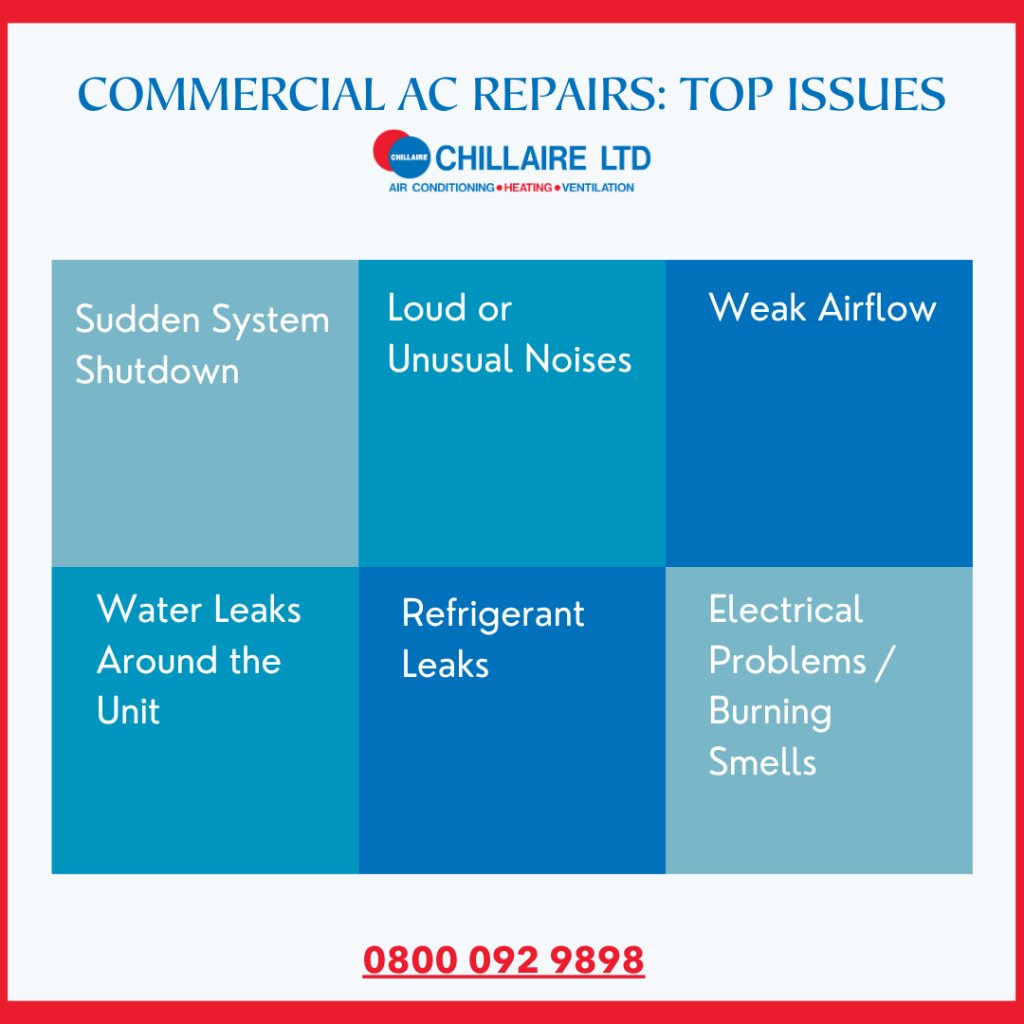
Sudden System Shutdown

One of the most obvious signs your commercial air conditioning system needs urgent repair is when it simply stops working.

Commercial HVAC and AC systems can shut down suddenly due to 

  • Electrical faults
  • Compressor problems 
  • System overloads

Inside most commercial units there are multiple electrical components, including circuit boards, transformers and contactors. If any of these parts fail, the system may shut down completely.

Electrical faults are never something to ignore. A professional engineer needs to inspect the electrical section and identify which component has failed before restarting the system safely. When your air conditioning is working properly, it also keeps your employees productive.

Experiencing a sudden AC shutdown? Contact Chillaire today for professional commercial AC repairs.

Loud or Unusual Noises

Commercial AC units naturally produce a steady hum while running. However, loud banging, rattling or screeching sounds are a sign that your AC needs immediate attention.

These noises often point to mechanical problems, such as:

  • Worn or loose blower belts
  • Misaligned or damaged pulley systems
  • Loose internal components vibrating inside the unit
  • Failing blower or fan motors
  • Damaged or unbalanced fan blades
  • Components beginning to wear down due to age

If you hear anything out of the ordinary, it’s best to arrange a commercial AC repair inspection before the damage becomes irreversible.

Weak Airflow or Poor Cooling

If your commercial building starts feeling warmer than usual, many people assume the thermostat is the problem. In reality, weak airflow usually means something inside your commercial air conditioning system isn’t working properly.

Common causes include:

  • failing blower motors
  • worn belts
  • blocked filters
  • airflow restrictions
  • damaged fans

Poor airflow is a common air conditioning fault but also a major warning sign that you need a commercial AC repair. This is because it forces the system to work harder than it should, which puts extra strain on components, wearing them down quicker.

Notice weak airflow or poor cooling? Contact Chillaire to restore proper airflow.

Water Leaks Around the Unit

Water pooling around a commercial AC unit might seem like a small issue at first, but it’s actually a sign of a blocked condensate drain or internal system issue.

Inside an air conditioning system, moisture collects during the cooling process and drains out through a condensate line. When that line becomes blocked, water can back up inside the unit.

This can lead to:

  • ceiling damage
  • mould growth
  • internal equipment damage

Leaks around a commercial HVAC unit are considered an issue that requires immediate attention, as the drainage system fault can develop into larger problems.

Refrigerant Leaks or Cooling Loss

Commercial air conditioning repairs are definitely needed if your system is running but struggling to cool the building. This could indicate that refrigerant levels are low.

Refrigerant circulates through coils and compressors to remove heat from the air. When leaks develop, the system loses cooling capacity, and eventually the compressor can fail completely.

Signs of a refrigerant problem can include:

  • reduced cooling performance
  • ice forming on coils
  • hissing sounds near the unit

Refrigerant leaks should always be treated as urgent because they reduce the efficiency of your AC system and can cause serious compressor damage if left unresolved.

Electrical Problems or Burning Smells

Electrical faults are another major reason commercial AC systems require emergency repairs.

Warning signs include:

  • burning smells
  • systems repeatedly tripping breakers
  • units turning off unexpectedly

These signs normally indicate overheating components, wiring faults or failing motors. If the system keeps shutting down or producing unusual smells, it should be switched off and inspected immediately by a commercial AC professional.

Smell burning or notice electrical issues? Call Chillaire for expert electrical AC repair before it escalates.

Commercial Air Conditioning Repair at Chillaire

At Chillaire, we have been designing and installing commercial air conditioning systems for over 30 years.

Our team works with a wide range of commercial systems used in offices, retail spaces, manufacturing facilities and other business environments. Our engineers are experienced across major AC brands, allowing them to quickly identify faults and carry out repairs to get your system back up and running.

For urgent issues, we also offer a 24-hour breakdown repair service. If your system is showing any of the signs we discussed, contact us today and we can assess the problem and carry out the repairs you need.

6 signs your air conditioner needs professional maintenance6 Signs Your Air Conditioner Needs Professional Maintenance 
Air conditioning systems usually show small changes in performance long before a complete breakdown. Weak airflow, unusual noises, rising energy bills and excessive moisture are all signs that your system may need professional attention. In this article, we will go through 6 signs that your air conditioning system needs professional maintenance.

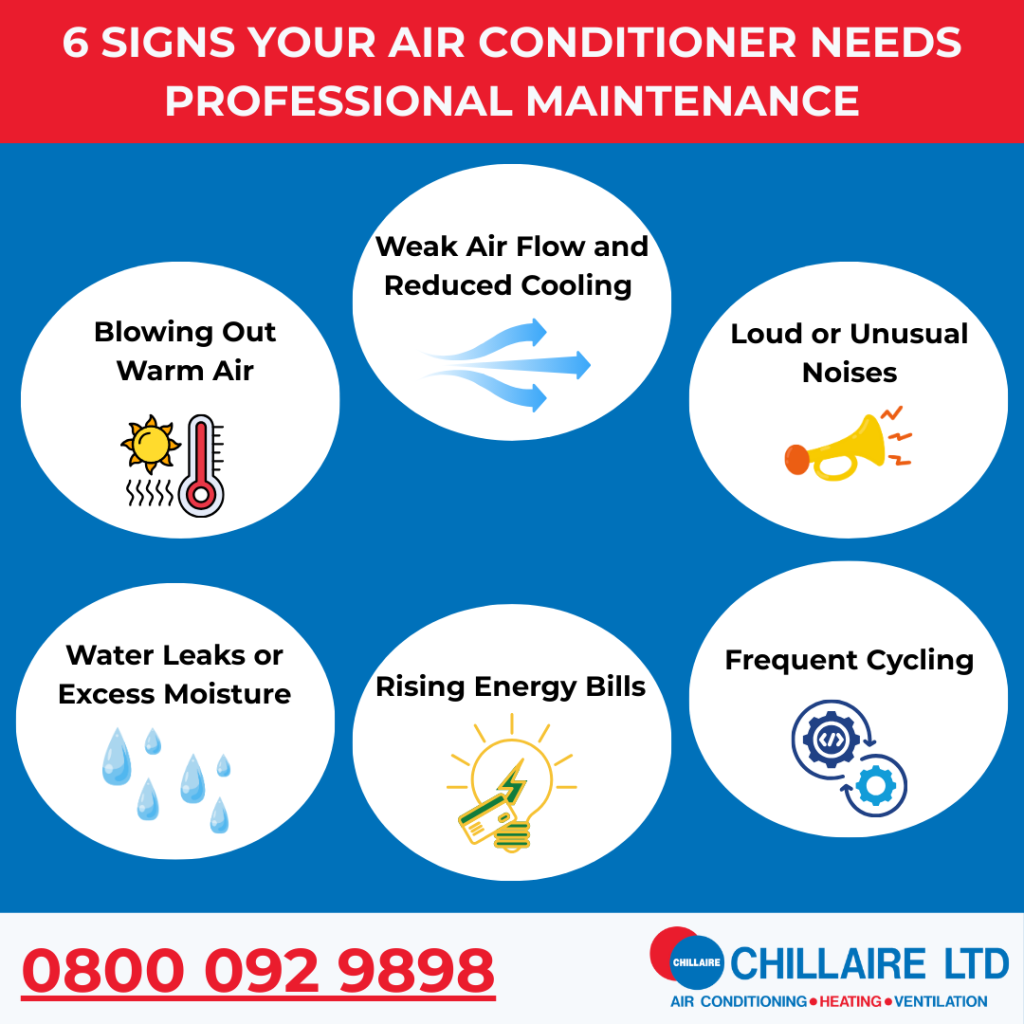
1. Weak Air Flow and Reduced Cooling 

When your air conditioner is no longer pushing out a strong flow of cool air, it’s usually a sign that something inside the system isn’t working as it should. Weak airflow is often caused by blocked or dirty air filters, restricted heat exchanger or a failing component within the unit. Any of these can stop air moving freely through the system.

Proper air conditioner maintenance allows a technician to identify the exact cause of the problem and return your AC to full functionality. 

Noticing weak airflow or poor cooling? Book your air conditioner maintenance today and let our engineers restore full performance before the problem gets worse.

2. Loud or Unusual Noises

An air conditioning system should run quietly, with little more than a gentle hum and the sound of air moving through the vents. If you start hearing loud or unusual noises such as whistling, grinding, rattling, banging or squealing, it’s a sign something is wrong with your air conditioner. 

  • Whistling noise often means that the filters are dirty and need cleaning or the heat exchanger is getting clogged up and requires cleaning, there may be trapped debris in the dampers or ducting. 
  • Rattling or banging often means there are loose or broken components, trapped debris or internal parts that have shifted out of place. 
  • Grinding noises usually point to a problem with the motor or bearings. 
  • Squealing can be a sign of a worn belt or a component struggling under strain. 

Ignoring these sounds can mean much worse internal damage for your AC. Booking a professional maintenance check for your air conditioner can repair and prevent any further damage.

Hearing strange noises from your AC? Our air conditioner maintenance service can identify the fault early and prevent costly internal damage.

3. Frequent Cycling (Short On/Off Periods or Not Turning Off)

Your air conditioner should follow a consistent cooling cycle, turning on and off at regular intervals. However, if you start to notice cycling more frequently than usual, it could be a sign that your AC needs professional maintenance. Short cycling can be caused by thermostat issues, low refrigerant levels or electrical problems. When your AC cycles too often, it struggles to maintain the desired temperature, putting unnecessary stress on the components. This will start to increase your energy consumption and shorten the lifespan of your AC. 

If you notice your AC short cycling, it’s best to book your air conditioning system maintenance as soon as possible.

Short cycling is a sign your system needs attention. Book your air conditioning system maintenance check with Chillaire to protect your equipment and improve efficiency.

If your air conditioner’s filters or heat exchangers become clogged, the system cannot deliver its full cooling or heating capacity. As a result, the air conditioner continues to run because it senses that the room has not yet reached the temperature set on the thermostat.

However, with restricted airflow and reduced efficiency, the unit may only be operating at around 50% of its potential output. This causes it to work much harder for longer periods, increasing your energy bills, accelerating wear and tear, raising maintenance costs, and ultimately shortening the overall lifespan of your air conditioning system.

4. Rising Energy Bills With No Explanation

If you have noticed that your energy bill just keeps increasing, despite no change to your usage, then it could actually be a sign that there is an issue with your AC.  A defective or unclean inefficient system will require more power to cool your building, which will cause higher electricity costs. 

Worn components, dirty air filters and refrigerant leaks all force the system to overcompensate and use more energy than necessary. Regular air conditioner maintenance helps keep energy consumption under control by making sure every part of the system is operating as it should.

If your energy bills are climbing, we can carry out professional air conditioner maintenance to restore efficiency and reduce unnecessary running costs.

5. Your AC is Blowing Out Warm Air Instead

If your air conditioner is blowing warm air, it’s a clear sign that something is wrong with your AC system. Several issues can cause this, including a failing compressor or thermostat. If your thermostat is set correctly but the unit still produces warm air, there may be a problem with the cooling cycle. Low refrigerant levels can stop the system from absorbing and removing heat effectively, while a damaged compressor will struggle to circulate the refrigerant needed for proper cooling.

A professional AC technician can find and fix these issues before they lead to further damage. 

Blowing warm air is a sign something isn’t right. Book your air conditioning maintenance check today, so we can quickly diagnose the issue and get your AC working properly again.

6. Water Leaks or Excess Moisture

Your air conditioner system naturally removes moisture from the air as it cools. However, another sign your AC requires professional maintenance is if you notice water pooling around the unit or excessive condensation. 

This could be down to a broken condensate pump or even a refrigerant leak leading to icing up of the heat exchanger. It’s important not to leave this unchecked, as excessive moisture can eventually lead to mould growth and water damage, which will ultimately damage your AC system. Mould growth is especially concerning because it can be circulated through the system and affect indoor air quality. 

A properly functioning AC unit should be draining moisture efficiently, so any signs of leakage should not be ignored. With regular air conditioning system maintenance, any water-related issue can be addressed so your AC can continue to run safely.

Noticing water around your unit or excess moisture? Contact us today, and our professional engineers can resolve drainage and moisture issues.

Professional Air Conditioner Maintenance at Chillaire

At Chillaire, we have been delivering professional air conditioner maintenance across the Midlands for almost 30 years. We work with commercial and industrial air conditioning systems. 

Our qualified engineers cover planned air conditioning system maintenance and servicing to help keep your equipment running efficiently. Every service is completed by professionals who understand current UK F-Gas regulations and safety requirements.

Book your professional air conditioner maintenance with Chillaire to ensure your AC system cools and performs at its best for years to come.

For advice on recognising when it’s time to replace your air conditioner system instead of just servicing it, see article on when you need an air conditioner replacement.

Chillaire
Air Conditioning - Heating - Ventilation